The Simple Button:
Optimized for Machines, Chosen by People, Built for Trust
BY AUDREY GOFF

The Why
Over twenty years ago, a red plastic button labeled "easy" became a desk toy and a shorthand people still reach for. Who couldn’t relate to the desire for life and work to feel less hard? Now, AI is delivering more than the easy button. It's delivering the simple button. Consider how a Google search has evolved. Not long ago, a query returned links for further exploration. Today, it returns an AI-generated answer that suffices most of the time.
This has big implications for brands, which have long worked to build direct relationships with customers: to earn attention, to make their case, and ultimately to be chosen. This two-sided effort between brand and consumer created a kind of relationship. Now, AI-powered simplification stands in the gap and does the work of choosing on the customer’s behalf. And the relationship goes where the effort goes: to whoever does the simplifying.
How
This relationship erosion is further along than it looks. A decade ago, fewer than half of U.S. Google searches ended without a click; today, about two-thirds do. News publishers are also feeling the hit. According to Reuters Institute, ongoing rollout of both AI Mode and AI Overviews to Google’s search experience is widely assumed to be affecting referral traffic to news websites. Google's organic traffic to news sites fell by a third in a single year, and publishers expect it to almost halve again within three years. The reader still gets informed, but the newsroom doesn’t get the click — or the relationship.
Commerce is a few steps behind and on the same path, but with a twist. According to Adobe's numbers, AI-referred shoppers generate more revenue per visit (+53%) than non-AI traffic, a massive swing from just 12 months ago when non-AI visits were worth 128% more. In this case, the mediated customer is no longer a lower-quality customer.
Less interaction with customers has wide-ranging impacts. If the customer doesn’t land on your site, then their data-rich visits, queries, and sign-ups stop arriving. If the machines can't see your organization, you get skipped. If nothing sets you apart, you get picked only when you're cheapest. When customers stop coming to you directly, you start paying whoever they go through instead, diminishing your margins. You’ll pay commissions to marketplaces, fees to delivery apps, and advertising dollars to search.
And this raises a harder question: How does a brand get chosen inside an AI answer? Winning the machine works nothing like winning the consumer. Machines don't read minds; they read records. Your standing gets assembled from what credible third parties say about you, rather than from the impression you made. Borrowed authority replaces earned authority.
The market is already pricing that in. Outside sources are valuable enough to the machines that platforms now buy them outright: Amazon pays The New York Times up to $25 million a year to put Times journalism inside Alexa and other Amazon products. And brands are taking note that AI answers get built from what’s already written. With LLMs replacing traditional search, Gartner predicts that PR and earned media budgets will double by 2027.
Trust Factor
Underneath all of this sits a question about trust, and it's older than the technology. Sociologists have long argued that trust exists to reduce complexity: We trust so we can stop evaluating. That has always been a brand's real work. A trusted name is a shortcut that spares people the effort of choosing. AI now does that job for everything at once, which is why people hand it their trust so readily.
So here’s the imperative: Build a record worth citing. The machines look for a record of what others have said about you. Make sure there's one worth finding. Also, the record has to be real. AI systems keep getting better at catching fake reviews and gamed profiles, which makes honesty the only version that lasts.
What's Next
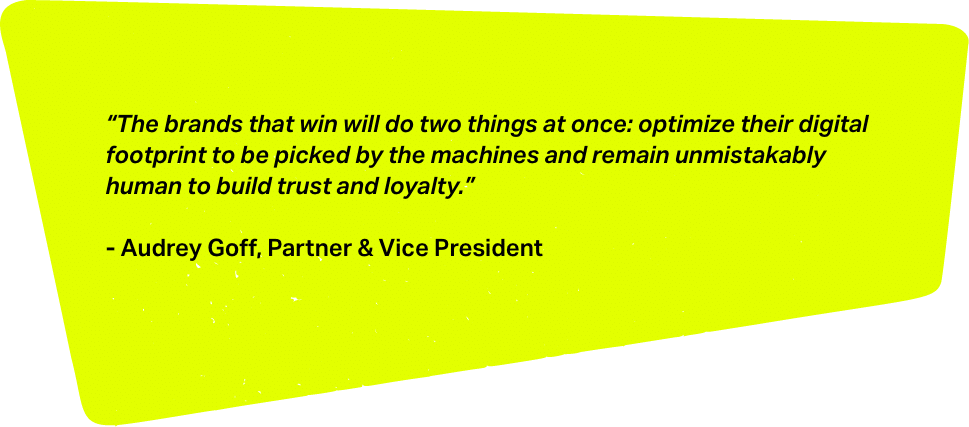
The brands that win in 2027 will be legible to the machine and unmistakably human everywhere else.
Start by looking. Find out what AI answers say about your brand today, and have your team pull the same for your two closest competitors so you have a comparison. Then ask your people how they made their last three purchases or picked their last vendor. Listen for how many took the simple answer instead of doing more research.
Make yourself visible to the machines. Start with your website, where you have the most control and where the gap is already measurable. (Adobe puts a score on this: The average retail product page rates 66% readable by machines.) But the machines read well beyond your site. Reviews, profiles, directories, and forums feed the answer too, alongside the expertise and press coverage you earn. All of it counts only if it's online where the machines can find it.
Protect the human moments. Some decisions carry too much weight to hand to a machine. Map which ones those are for your customers, and put your best people there.
Sources: Similarweb · Reuters Institute · Adobe