The Orchestration Advantage:
Rise of the AI Conductor
BY TERRIE ARD

The Why
Think of AI integration like a musical ensemble. Until now, most organizations have focused on improving their overall performance by adding instruments and soloists — the tools and talent. Now, organizations are being challenged to take AI to new levels of integrated harmony by braiding AI systems that can plan, decide, and execute across entire workflows.
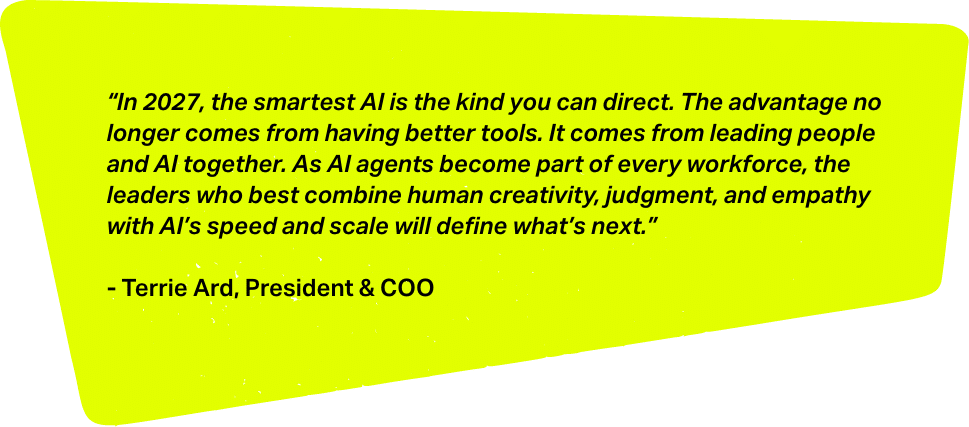
In 2027, success will require more than playing AI like single instruments. The new competitive edge is learning to conduct AI systems like a maestro.
How
Organizations are now building capacity to coordinate fleets of specialized agents effectively across operations. Deloitte finds 74% of organizations expect to be using AI agents at least moderately by 2027, with 23% expecting to use them extensively. Gartner projects that by 2028, at least 15% of day-to-day work decisions will be made autonomously — up from zero in 2024.
By 2028, a third of enterprise software will ship with agentic AI built in — up from less than 1% in 2024.
Gartner projects more than 40% of agentic AI projects will be scrapped by the end of 2027 — felled by escalating costs, unclear value, and inadequate risk controls.
Microsoft’s blueprint for the organizations of the future puts it plainly: “AI-operated, but human-led” — where employees become an “agent boss” who builds, delegates to, and conducts a team of agents. The AI orchestration trend will accelerate in two ways in 2027:
The Organizational Actor. As AI tools lift heavier loads, they take longer. The length of task an AI can reliably complete has doubled roughly every seven months since 2019 and every four months since 2024. A two-hour agent is a productivity tool. A four-day agent is an organizational actor — one that needs governance, an oversight structure, defined autonomy boundaries, and human checkpoints.
The Control Plane. Organizations will create central dashboards that sit above AI agents, letting people oversee what the agents are doing, set the rules they follow, and step in whenever something needs a human’s judgment. This lets a company automate its routine work. People can shift from doing every task themselves to supervising and making the bigger decisions.
McKinsey estimates 75% of roles will need fundamental reshaping for AI.
Trust Factor
According to Deloitte, only 21% of respondents say their organizations have a mature governance model in place for agentic AI. Orchestration is more than an IT capability. It is a human leadership competency, with governance acting as the conductor’s baton. The best musicians become so through hard work and consistent practice. Organizational leaders must adopt a similar discipline, emphasizing that agents be directed with transparency, accountability, and in ways that hold up to regulatory scrutiny.
What's Next
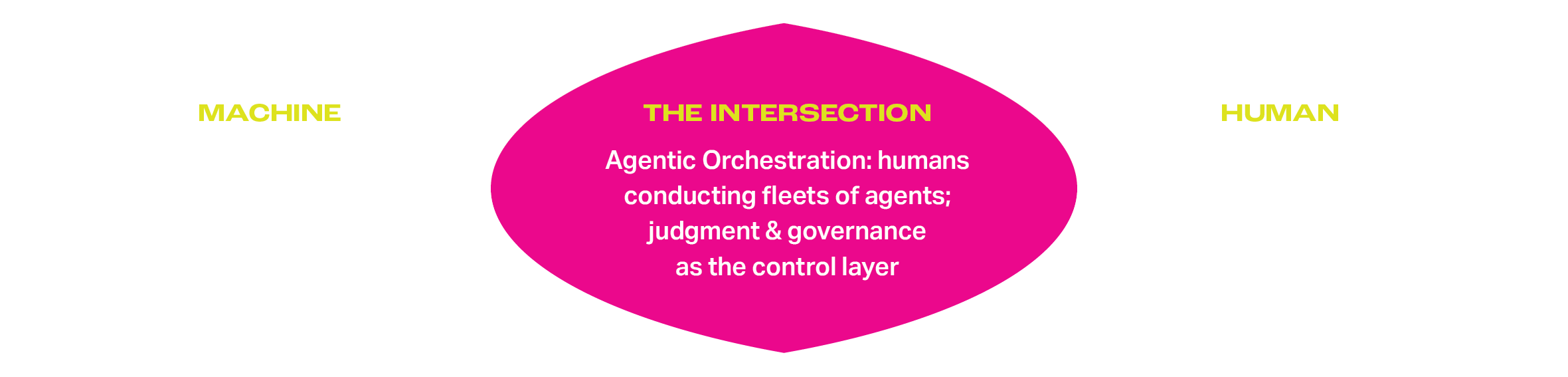
Build the orchestration layer. Design end-to-end workflows around human–agent handoffs. Make governance a prerequisite. Reposition your people as conductors, moving them up to higher-order work — judgment, direction, and oversight — while agents take on execution. The bottleneck is leadership and work redesign, not employee readiness or technology access.
There is a window in 2027 where orchestration is a true differentiator. The advantage won’t go to whoever adopts agents fastest, but to whoever learns to conduct them best. And the advantage compounds. Beyond 2027, the same skill extends to agent-to-agent commerce: low-cost AI concierges that negotiate with other agents around the clock and transact on our behalf, on decisions as big as home-buying or estate planning.
Conducting today’s agents is how you get ready to conduct tomorrow’s.