Made by People:
The Edge in the Age of Infinite AI
BY: Jordan Jacobs & Fern Senra-James

The Why
In 1969, Seiko's quartz watch arrived, and it was cheaper and more accurate than anything previously made. The Swiss watch industry nearly didn't survive; roughly two-thirds of Swiss watchmaking jobs disappeared between 1970 and 1984. The prestige end of the Swiss industry survived by making mechanical watches scarce on purpose: hand-finished, limited, and positioned as heirlooms. Today, a Patek Philippe can sell for hundreds of thousands of dollars while some claim it keeps worse time than a $20 quartz. Buyers aren't paying for accuracy. They're paying for not only the status of owning something scarce, but also the human hours behind it and the story it carries.
That is the pattern generative AI is about to repeat across the economy. For decades, competitive advantage came from producing more — more content, more analysis, more reach. Now, high-quantity output is both instant and infinite. While that tier of performance suffices in certain circumstances, discerning organizations and consumers want to know a human is behind the work. The premium now belongs to humans based on their craft, judgment, and accountability.
How
Sometimes, the human premium is credited to personal accountability. For example: Machine translation is free and fast, yet courts, hospitals, and immigration offices still require certified human translation for their documents. The value isn't the words; it's the responsibility attached to them. Did a person look before a patient hears the results? Can a citizen trace information back to who approved it? Accountability is what matters.
In other cases, the human premium is based on creativity and craft. Even a decade ago, shoppers paid about 17% more for handmade goods than machine-made ones. Today, work is often perceived as less valuable once people know AI made it. In one controlled study of AI-created music, listeners couldn't tell the difference and even slightly preferred the AI tracks. But once they were told AI had made the compositions, they appreciated it less and were less willing to pay for it. That instinct is shaping brand preference: Half of consumers now say they’d rather give their business to brands that don’t use GenAI in their consumer-facing messaging, content, or advertising. Organizations can remain relevant by ensuring AI-generated information has human oversight of the work.
Just 5% of organizations consider themselves leaders at blending human and AI decision-making, even as 60% of executives now use AI regularly. (Deloitte)
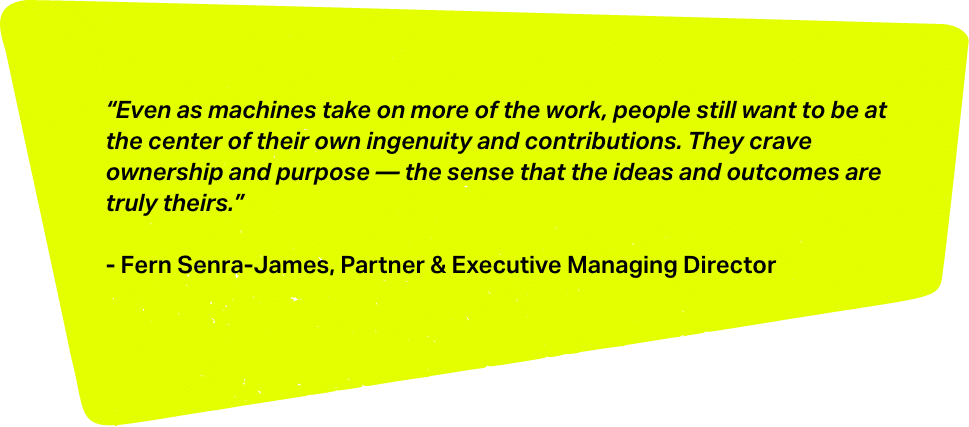
But accountability, creativity, and craft aren't the whole of it. Knowing a person is behind the work creates a feeling of connection. In a world of infinite synthetic output, people increasingly crave the sense that a real human is on the other side. There's emotional value in knowing someone chose to make this, and they meant it for you.
As consumer skepticism grows, 68% of people frequently question the authenticity of the content and information they see. (Gartner)
Trust Factor
At enterprise scale, the “human premium” becomes something you have to prove. It isn't about proving that a human participated; it's proving that a human is accountable. What earns trust is the ability to answer three questions: Who created it? Who reviewed it? Who owns the outcome?
Trust runs both ways: Audiences must believe a human is answerable, and leaders must trust their people to make the calls a machine can't.
What's Next
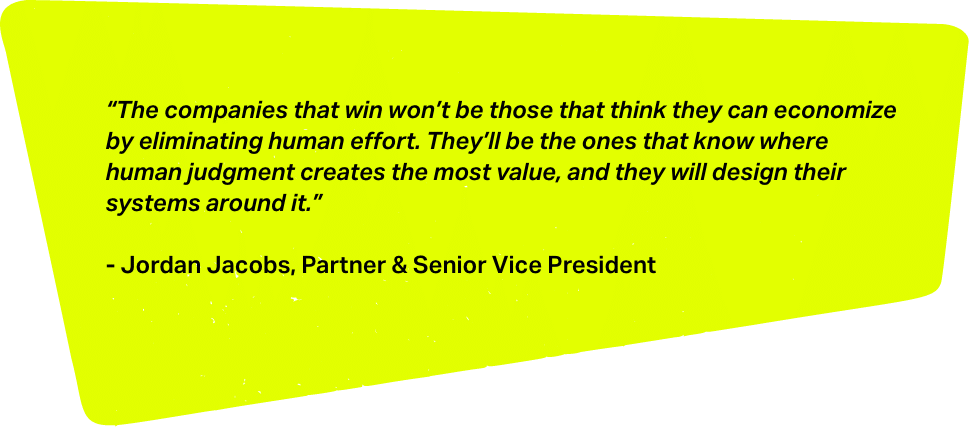
The human premium concentrates wherever judgment, consequence, and connection matter most. For leaders, the opportunity is to design those moments.
- Map where human judgment actually changes your outcomes, and staff them deliberately.
- Build the systems that can answer those three questions. (Who created it? Who reviewed it? Who owns the outcome?)
- Treat "made by people" as a provable feature of your brand.
We spent the last decade optimizing for speed. The next decade belongs to organizations that know when speed should give way to the human — the craft, the judgment, and the person willing to put their name on the work.