Verified Voices:
The New Standard for Influence
By: Liz Underwood & Courtney Cox
The Why
Raising our voices for the causes we care about is one of the most basic ways people shape the world around them. We sign petitions, flood public comment periods, and rally our communities. We know when enough people speak, leaders listen and change follows. That collective voice has always been the raw material of influence.
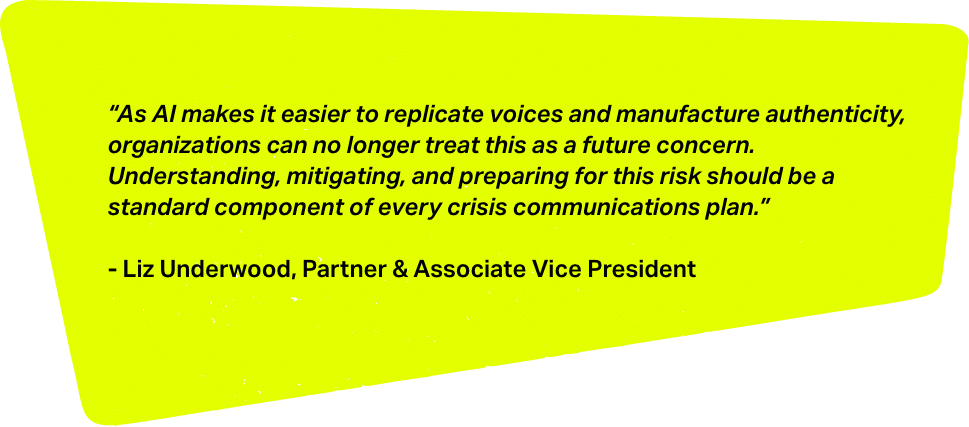
In the age of AI, raw material can be counterfeited. Organizations are entering a reality where public sentiment, stakeholder feedback, and grassroots support can be manufactured, amplified, and shaped with speed and precision. The risk is even bigger than fake content: it’s fake consensus. When AI systems can conjure the appearance of a movement before anyone confirms the people behind it are real, leaders may misread the moment and overcorrect, underreact, or acti on pressure that was manufactured.
How
A sudden flood of comments, a wave of similar personal stories, a spike in advocacy activity — any of it may reflect genuine concern. Or it may reflect artificial coordination engineered to look organic.
This is no longer hypothetical. In early 2026, a Los Angeles Times investigation found that a California air quality district received roughly 20,000 comments — many more than usual — opposing a proposed pollution rule. The agency decided to check for authenticity and reached out to a small sample of 172 commenters, and several indicated they knew nothing about comments filed under their names, a strong sign the surge was manufactured.
Deloitte's 2026 Human Capital Trends research found that 48% of executives worry AI could introduce misinformation into their organization's data.
Researchers at USC's Information Sciences Institute modeled what a coordinated AI network might look like, running a simulated social platform populated entirely by bot agents. Even simple agents, they found, could "autonomously coordinate, amplify one another, and push shared narratives online without human control." It was a controlled simulation, but the lesson for leaders is plain: What works in the lab is a short step from the wild. When manufactured activity looks human at first glance, every public-facing issue — regulatory debates, economic policy, advocacy campaigns, brand reputation — becomes harder to trust.
Among every threat facing the world, the World Economic Forum ranks misinformation and disinformation the No. 2 global risk of the next two years.
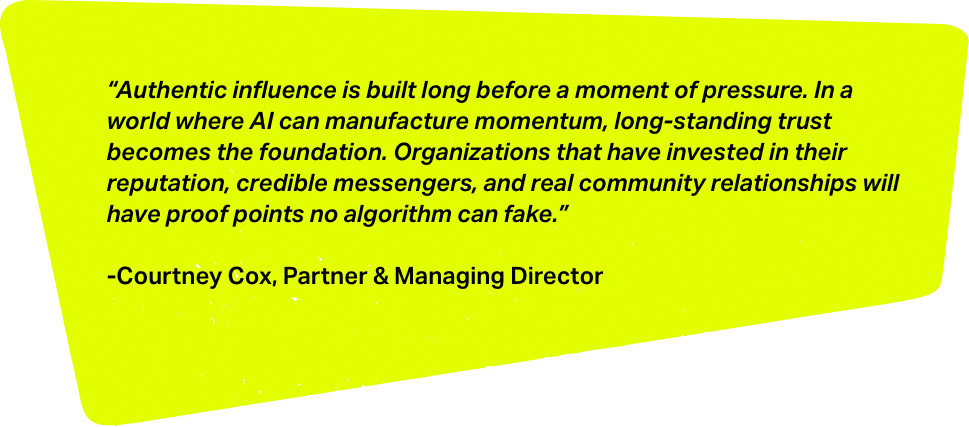
As synthetic voices grow more sophisticated, authenticity becomes harder to prove and more valuable to protect. Detection tools will keep improving, but so will the fakes. The organizations that hold their ground will be the ones that can point to credible messengers, trusted relationships, owned channels, and a documented record of engagement that proves who stands behind their message.
Trust Factor
The threat is serious enough that governments are already responding: Gartner predicts that 40% of government organizations will establish "TrustOps" teams to counter deepfake threats by 2028. Synthetic voices do damage in both directions: A fabricated movement can be believed, and a genuine one can be dismissed as fake. Leaders must exercise discretion and care to avoid making mistakes on either side.
What's Next
Start with community. Build trusted networks before you need them. The organizations that can respond credibly under pressure are the ones that already have real relationships with the communities closest to the issue.
Create pathways for participation. Don't speak for your stakeholders when you can make space for them to speak for themselves. Standing advisory councils, community roundtables, and verified stakeholder panels give you a documented record of who was consulted, what they said, and how it shaped your strategy. And don't underestimate the power of face-to-face: When almost anything online can be manufactured, presence is the one signal a synthetic voice can't fake.
Validate before you react. Reactive advocacy has its place, but speed without verification is its own risk. Build a protocol that watches patterns: Manufactured activity tends to arrive in bursts, echo the same phrasing, and amplify itself on an unnatural clock. Behavioral and network-analysis tools like Cyabra and ZeroFox can surface those signals at scale. Don't lean on AI-text detectors to make the call; they're unreliable, and a false positive means dismissing real people as bots.